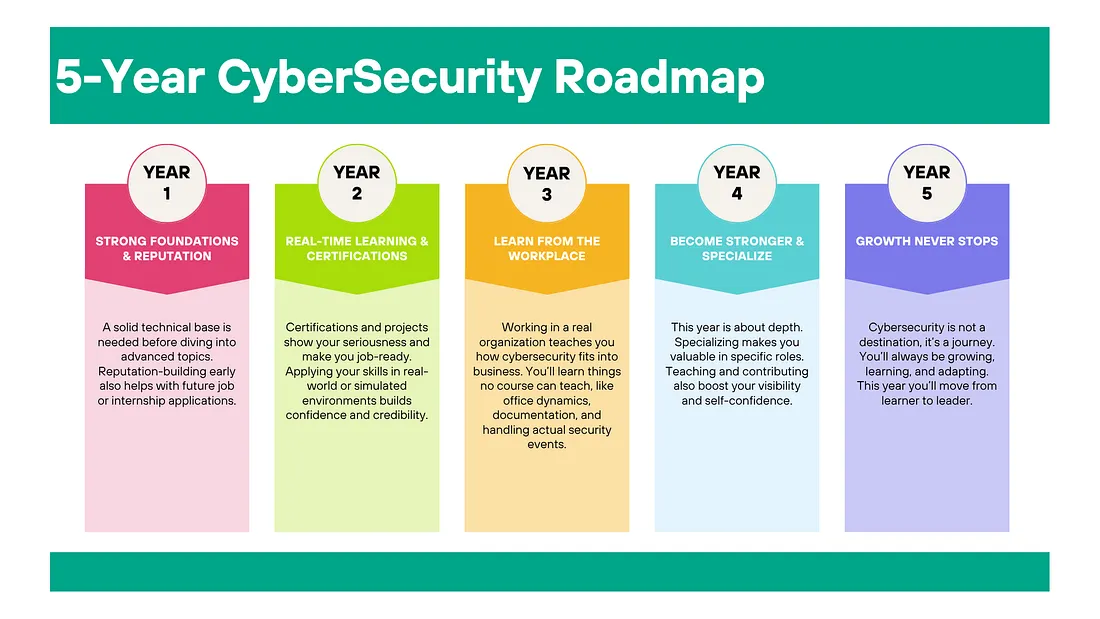
This is my personal 5-year roadmap to becoming a cybersecurity professional. Before diving into the roadmap, here are the core principles that guide my journey:
Core Principles :
Fundamentals: Without a strong foundation, you can’t build anything solid. Mastering the basics is essential.
Continuous Learning: Technology and threats evolve. Staying updated is the only way to stay relevant.
Hands-On Practice: Learning theory is not enough, apply what you learn in real scenarios.
Learning from Mistakes: Mistakes are part of growth. Learn from them and don’t repeat them.
Teamwork: You can’t solve everything alone. Collaborate, communicate, and grow with a team.
Networking: Build genuine relationships with people, even outside your field, they may open unexpected doors.
Certification: Certifications validate your knowledge and help you stand out professionally.
The Roadmap
Year 1: Build Strong Foundations & Reputation
Develop a deep understanding of the basics and begin building your personal brand. A solid technical base is required before moving forward, and early reputation-building helps with future opportunities.
What to do:
Learn networking fundamentals (IP, DNS, TCP/IP, ports)
Study Linux and Windows basics
Understand cybersecurity concepts: CIA triad, firewalls, malware, encryption
Learn basic Python or Bash scripting
Set up a local lab using VMware or VirtualBox
Start sharing your learning (blog, LinkedIn, GitHub)
Year 2: Real-Time Learning & Certifications
Apply your knowledge in real or simulated environments and earn recognized certifications. This will show your seriousness and boost your credibility.
What to do:
Join CTF platforms (TryHackMe, Hack The Box)
Explore tools like Wireshark, Nmap, Burp Suite, Metasploit
Begin exploring roles (Red Team, Blue Team, SOC, GRC, etc.)
Get entry-level certifications (CompTIA Security+, CEH, etc.)
Work on small personal or freelance cybersecurity projects
Contribute to GitHub or security communities
Year 3: Learn from the Workplace
Gain hands-on experience in a real-world environment and understand how cybersecurity integrates with business. Work experience will teach lessons that theory can’t.
What to do:
Get an internship or entry-level job in IT or security
Gain experience with monitoring tools (like SIEMs), tickets, and incidents
Understand company security policies, risks, and compliance
Communicate and collaborate across technical and non-technical teams
Pursue mid-level certifications (CySA+, OSCP, SC-200)
Year 4: Become Stronger & Specialize
Master your chosen area and start contributing back to the community. Specializing makes you more valuable, while giving back builds reputation and leadership.
What to do:
Choose your specialization (Red Team, Blue team, Cloud Security, Forensics, etc.)
Learn advanced tools and techniques
Start mentoring others or answering questions in forums
Attend and speak at conferences or webinars
Continue advancing certifications (e.g., CISSP, OSCE, AWS Security)
Year 5: Growth Never Stops
Evolve from a practitioner to a leader. Keep expanding your knowledge, network, and impact. Stay curious, because the journey never ends.
What to do:
Keep up with trends (AI in security, zero trust, etc.)
Join new communities or start one
Lead security projects or strategic initiatives
Explore content creation: write articles, make videos, build tools
Plan for future roles: leadership, consulting, or entrepreneurship